




- US - English
- China - 简体中文
- India - English
- Japan - 日本語
- Malaysia - English
- Singapore - English
- Taiwan – 繁體中文

Robots are programmable machines that sense their environment, process information and perform physical tasks. From industrial robotic arms and autonomous mobile robots to drones, surgical systems and humanoids, robots vary widely in their function, level of autonomy and physical design, with many fitting into multiple categories. In this guide, we'll explore the major types of robots, how they work and where they're used across industries. We'll also examine how advances in AI, edge computing, memory and storage are enabling robots to process data, make real-time decisions and operate more intelligently than ever before.
How robots are classified
Robots are typically classified based on three key characteristics: their function, level of autonomy and physical design. Function refers to the task a robot performs, such as manufacturing, healthcare, logistics or inspection; autonomy describes how independently it operates, ranging from fully remote-controlled systems to robots that make decisions on their own; and design refers to its physical form, such as a robotic arm, wheeled vehicle, drone or humanoid machine. Because these classifications often overlap, many robots fit into multiple categories at the same time, such as an autonomous mobile robot used for warehouse logistics.
Industrial robots
Industrial robots are automated machines designed to perform manufacturing tasks with high speed, precision and consistency. They are commonly deployed in factories and production facilities where repetitive, physically demanding or highly accurate work is required. As industrial manufacturing becomes increasingly connected and data-driven, industrial robots are also incorporating AI, machine vision and advanced sensing technologies to improve flexibility and productivity.
Common types
- Articulated robots: Multi-jointed robotic arms used for complex, flexible movements and a wide range of manufacturing tasks.
- Selective compliance assembly robot arm (SCARA) robots: Fast, precise robots designed for repetitive assembly and pick-and-place operations.
- Cartesian robots: Robots that move along fixed linear X, Y and Z axes, making them ideal for highly accurate positioning tasks.
- Delta robots: Lightweight robots built for high-speed picking, sorting and packaging applications.
Common use cases
- Automotive manufacturing
- Semiconductor and electronics production
- Packaging and palletizing
- Welding and painting
Service robots
Service robots are designed to assist people and organizations by performing tasks outside of traditional manufacturing environments. They can operate in hospitals, warehouses, farms, homes and public spaces, helping improve efficiency, safety and productivity.
Professional service robots
Common types
- Medical robots: Assist with surgery, diagnostics and patient care.
- Logistics robots, including autonomous mobile robots (AMRs) and automated guided vehicles (AGVs): Automate warehouse movement, transportation and fulfillment operations, and last-mile delivery.
- Agricultural robots: Support planting, harvesting, crop monitoring and precision farming.
- Inspection robots: Monitor infrastructure, facilities and industrial equipment.
Common use cases
- Surgery and healthcare support
- Warehouse automation
- Farming and harvesting
- Infrastructure inspection
- Last-mile delivery
Personal service robots (consumer robots)
Common types
- Robot vacuums: Autonomous home cleaning devices.
- Lawn care robots: Automated mowing and lawn maintenance systems.
- Home assistants: Robots that support everyday household tasks.
- Companion robots: Designed for interaction, engagement and support.
Common use cases
- Home cleaning
- Personal assistance
- Elder care and companionship
Mobile robots
Mobile robots are designed to move through their environment rather than operate from a fixed location. These robots use sensors, software and navigation technologies to travel safely and efficiently through warehouses, facilities, cities and outdoor environments. While some mobile robots like AMRs and AGVs are classified as service robots based on their function, they are also considered mobile robots because their primary characteristic is autonomous movement through an environment.
Many mobile robots rely on simultaneous localization and mapping (SLAM) technology, which enables them to build maps of their surroundings while simultaneously determining their location, supporting autonomous navigation, obstacle avoidance and real-time route planning.
Common types
- Autonomous mobile robots: Navigate dynamically using sensors, software and AI.
- Automated guided vehicles: Follow predefined routes, markers or tracks.
- Delivery robots: Transport goods in controlled facilities or public environments.
- Drones (unmanned aerial vehicles, or UAVs): Flying robots used for aerial inspection, mapping and monitoring.
Common use cases
- Warehouse and fulfillment centers
- Last-mile delivery
- Video security and monitoring
- Mapping and navigation
Autonomous robots
Autonomous robots can operate with minimal human intervention by using sensors, AI models and software to perceive their environment, make decisions and execute actions. These systems represent a major shift from programmed automation to intelligent machines capable of adapting to dynamic conditions in real time.
Common types
- Self-driving vehicles: Navigate roads and environments without direct human input.
- Autonomous drones: Perform aerial tasks independently using onboard intelligence.
- Exploration robots: Operate in space, oceans and hazardous locations with limited human oversight.
Common use cases
- Transportation and mobility
- Exploration
- Defense and surveillance
Collaborative robots (cobots)
Collaborative robots or cobots, are designed to safely work alongside people in shared workspaces. Unlike traditional industrial robots that often operate behind safety barriers, cobots use sensors and safety systems that allow them to interact more closely with human workers.
Common types
- Industrial cobots: Work alongside employees in manufacturing and assembly environments.
- Vision-enabled cobots: Use cameras and computer vision to identify and interact with objects.
- Lightweight cobots: Flexible robotic systems designed for easy deployment and reconfiguration.
Common use cases
- Assembly line support
- Electronics manufacturing
- Small-batch production
Humanoid robots
Humanoid robots are designed to resemble humans in appearance, movement or interaction. By combining advanced AI, perception systems, mobility and dexterous manipulation, they aim to operate in environments originally built for people.
Common types
- Bipedal robots: Walk on two legs in a human-like manner.
- Social robots: Designed for communication, interaction and engagement.
- Android robots: Built to closely resemble human appearance and behavior.
Common use cases
- Research and development
- Customer interaction
- Human-robot interaction studies
- Manufacturing and industrial operations
- Research and development
- Customer interaction and service roles
- Human-robot interaction studies
Teleoperated robots
Teleoperated robots allow human operators to control robotic systems remotely. They are commonly used when tasks require human expertise but involve environments that may be dangerous, inaccessible or unsuitable for direct human presence.
Teleoperated robots allow human operators to control robotic systems remotely. They are commonly used when tasks require human expertise, precision or decision-making, whether operating in hazardous environments, inaccessible locations or highly specialized settings such as robotic-assisted surgery.
Common types
- Bomb disposal robots: Safely inspect and handle hazardous devices.
- Surgical robots: Controlled by surgeons to perform highly precise procedures.
- Underwater ROVs: Remotely operated vehicles used in deep-sea environments.
Common use cases
- Hazardous environments
- Medical procedures
- Deep-sea exploration
Swarm robots
Swarm robotics involves multiple robots working together to accomplish tasks through coordinated behavior. Instead of relying on a single machine, swarm systems distribute work across many robots, creating flexible and scalable robotic networks.
Common types
- Drone swarms: Groups of drones that coordinate actions and share information.
- Warehouse robot fleets: Large groups of logistics robots that work together to move inventory efficiently.
Common use cases
- Coordinated search operations
- Inventory movement and logistics
- Environmental monitoring
Soft robots
Soft robots are built from flexible materials that allow them to bend, stretch and adapt to their surroundings. Their ability to safely interact with people and delicate objects makes them well suited for tasks that would be challenging for traditional rigid robots.
Common types
- Soft robotic grippers: Handle delicate objects without causing damage.
- Flexible inspection robots: Navigate tight, complex or hard-to-reach spaces.
- Robotic exoskeletons: Assist or enhance human movement for rehabilitation, industrial work and mobility support.
Common use cases
- Minimally invasive surgery
- Rehabilitation and exosuits
- Safe human collaboration
- Extreme and underwater exploration
- Delicate handling and sensing
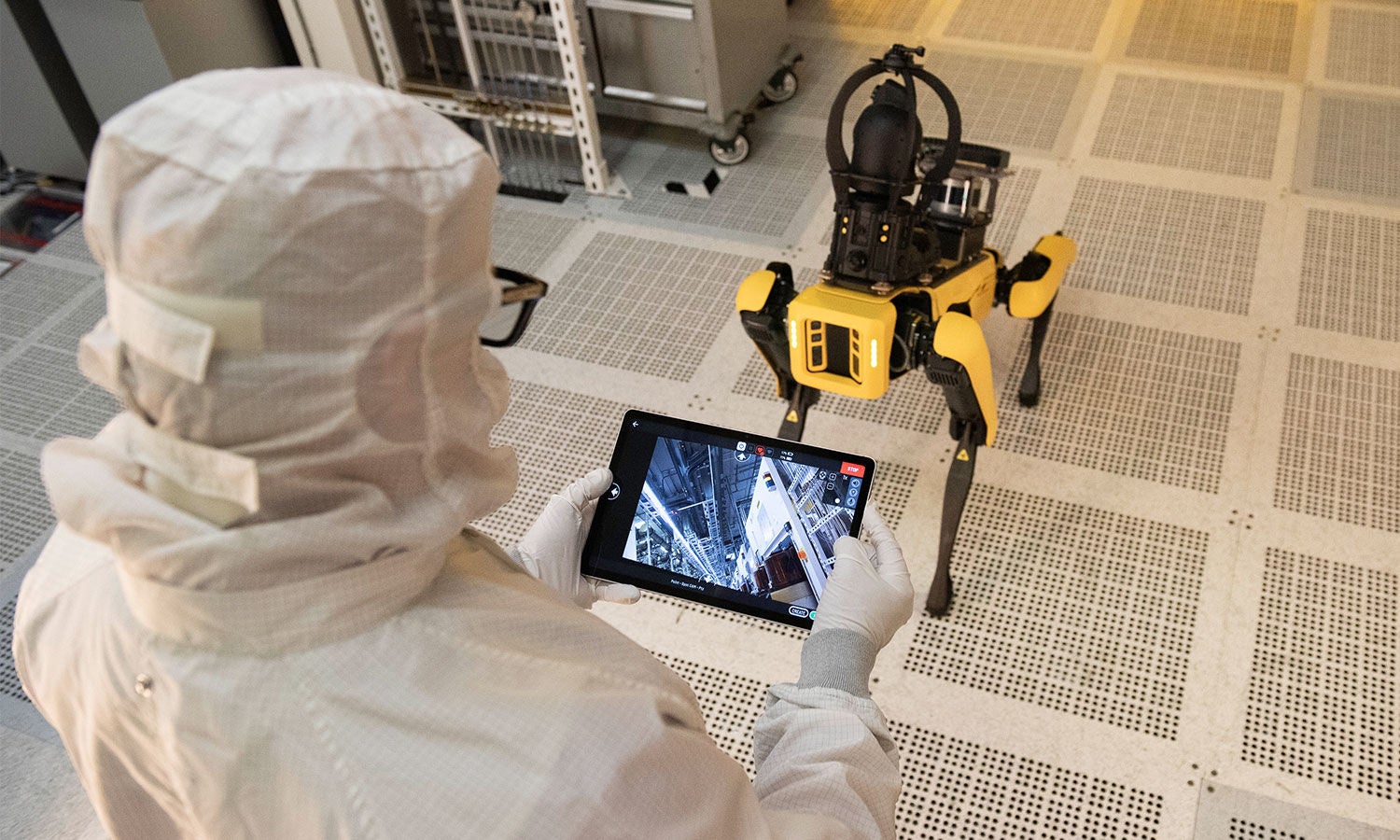 A robotics system supports semiconductor facility inspection.
Click image to expand
Biomimetic robots
Biomimetic robots are inspired by biological organisms and natural movement patterns. Engineers study animals, insects and other living systems to create robots that can navigate environments and perform tasks in ways that conventional machines cannot.
Common types
- Quadruped robots: Four-legged robots modeled after animals and designed for stability on uneven terrain.
- Snake robots: Flexible robots built to move through confined or challenging spaces.
- Flying bio-inspired robots: Robots modeled after birds or insects for agile and efficient flight.
- Biohybrid robots: Systems that combine mechanical components with biological elements, such as sensors derived from living organisms.
- Animal-interaction robots: Designed to interact with animals in research and behavioral studies.
Common use cases
- Search and rescue in hazardous or hard-to-reach environments
- Exploration in complex or unpredictable terrain
- Research and experimentation in robotics, biology and AI
- Odor detection and environmental sensing using biohybrid systems
- Studying animal behavior and collective intelligence through human-robot-animal interaction
Robots by industry
Robots are used across nearly every major industry, helping organizations automate repetitive tasks, improve operational efficiency and augment human capabilities. While the underlying technologies may be similar, each industry deploys robots in unique ways.
Healthcare robots
Healthcare robots support a wide range of medical applications, including robotic-assisted surgery, hospital automation, rehabilitation and diagnostics. Surgical robots enable greater precision during complex procedures, while mobile service robots help transport supplies, medications and equipment throughout healthcare facilities. Robots are also increasingly used in physical therapy and rehabilitation programs, helping patients recover mobility and improve outcomes.
Agricultural robots
Agricultural robots help farmers improve productivity while addressing labor shortages and resource constraints. These systems can assist with harvesting crops, monitoring plant health, applying fertilizers with greater precision and collecting field data to support decision-making. Combined with AI and sensor technologies, agricultural robots are helping advance precision farming practices that maximize yields while reducing waste.
Logistics and warehouse robots
Logistics and warehouse robots have become a core component of modern fulfillment operations. Autonomous mobile robots and automated guided vehicles move inventory throughout warehouses, support order picking and automate material transport. By streamlining inventory movement and reducing manual handling, these robots help increase efficiency, improve accuracy and accelerate order fulfillment.
Retail robots
Retail robots are used to automate routine tasks and improve the customer experience within stores. Common applications include shelf scanning to monitor inventory levels, automated stock checks and customer assistance for product location and information. These systems help retailers maintain inventory accuracy while allowing employees to focus on higher-value customer interactions.
Security robots
Security robots provide continuous monitoring and situational awareness across commercial, industrial and public environments. Equipped with cameras, sensors and AI-powered analytics, they can perform autonomous patrols, monitor restricted areas, detect unusual activity and support threat identification. These robots support video security by helping organizations monitor spaces more efficiently without requiring constant human oversight.
Space robots
Space robots play a critical role in extraterrestrial exploration and scientific research. Planetary rovers explore the surfaces of other worlds, robotic arms perform maintenance and sample collection tasks, and autonomous spacecraft support missions in environments that are inaccessible to humans. These systems enable scientists and engineers to gather data, conduct experiments and expand our understanding of space while operating in some of the most challenging environments imaginable.
For a closer look at these applications, explore our aerospace and defense resources.
While robots can be classified in many ways, there are several key categories driving the most significant commercial investment today. Industrial robots, autonomous mobile robots, service robots and emerging humanoid systems are increasingly being deployed across manufacturing, logistics, healthcare and consumer environments. These applications also represent some of the fastest-growing opportunities for AI-enabled robotic systems that rely heavily on memory and storage.
 Autonomous robotics system operating with a Micron team member inside a semiconductor fabrication facility
Click image to expand
The future of robotics
Robotics is entering a new era driven by advances in artificial intelligence, automation and edge AI. As robots evolve from performing predefined tasks to perceiving, reasoning and acting in dynamic environments, they are becoming more capable, adaptable and autonomous across industries. Memory and storage are playing an increasingly important role in supporting this shift by enabling robots to process and move data efficiently at the edge.
AI in robotics
Artificial intelligence and machine learning are making robots more independent, allowing them to perceive their surroundings, adapt to changing conditions and make decisions with minimal human intervention. As real-time decision-making becomes a standard requirement, robots rely on memory and storage to process sensor data, run AI models and store maps, environmental information and task history that support autonomous operation.
Why modern robots need high-performance memory
As robotics workloads become more data intensive, memory and storage play a critical role in overall system performance. Low latency helps robots react quickly to changing conditions, while high bandwidth supports the constant flow of sensor, vision and AI data. Reliable memory and storage also enable mission-critical operation and edge processing, reducing dependence on cloud connectivity while supporting faster, more responsive robotic systems.
FAQs
A mobile robot is any robot capable of moving through its environment, while an autonomous robot can make decisions and perform tasks with minimal human intervention. Many robots are both mobile and autonomous, but a mobile robot can also be remotely controlled or follow predefined routes rather than making independent decisions.
Robots are widely used in manufacturing, healthcare, agriculture, logistics, retail, security and aerospace. Applications range from factory automation and warehouse fulfillment to robotic surgery, crop monitoring, inventory management and planetary exploration.
Artificial intelligence enables robots to perceive their environment, interpret sensor data, recognize objects, learn from experience and make decisions in real time. This allows modern robots to operate more independently and adapt to changing conditions without requiring constant human oversight.
Memory and storage help robots process sensor data, run AI and machine learning models, store maps and environmental information, and maintain operational history. As robotics systems become more autonomous and data intensive, high-performance memory and storage play a critical role in enabling real-time decision-making and reliable operation.

