




- US - English
- China - 简体中文
- India - English
- Japan - 日本語
- Malaysia - English
- Singapore - English
- Taiwan – 繁體中文
Quick Links
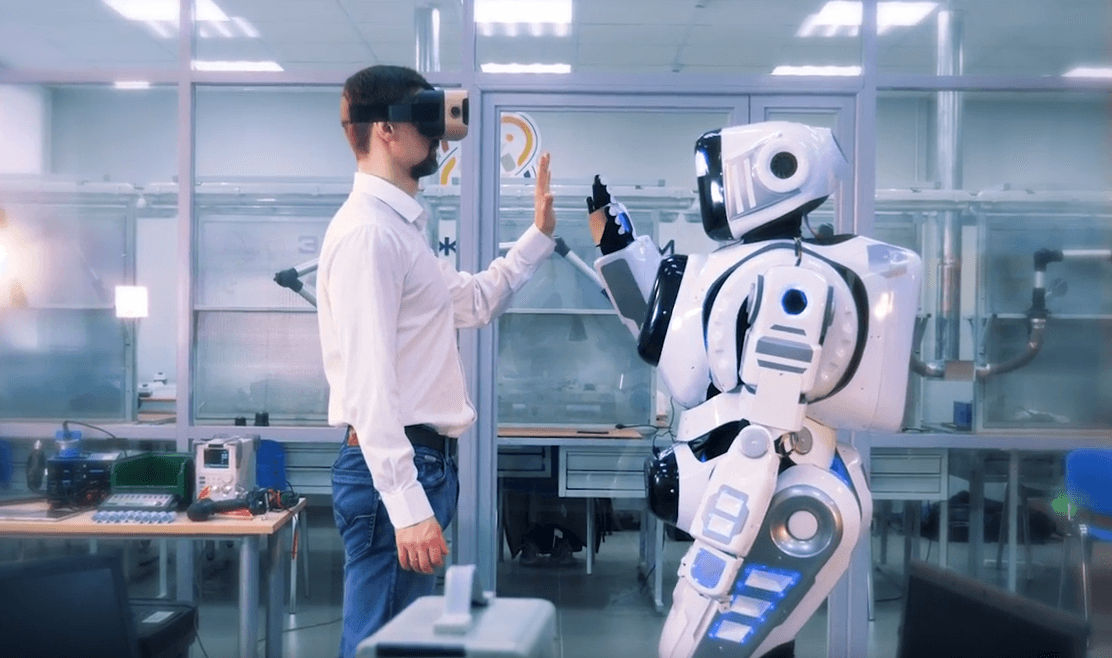
Humanoids As artificial intelligence advances from cloud infrastructure into the physical world, humanoid robots are emerging as one of the most transformative and semiconductor-intensive platforms of the coming decade. These machines bring together real-time perception, autonomous decision-making and precision motion control in a mobile, human-scale form factor — making them as complex as they are consequential. Humanoids represent the convergence of robotics, AI inference , and advanced memory and storage technologies, signaling a new era of embodied intelligence across global industries.
What are humanoids?
Humanoid robots are autonomous or semi-autonomous machines designed to replicate the physical form and functional capabilities of the human body. They integrate AI inference, sensor arrays, actuators, and a dense stack of semiconductor components to perceive their environment, make decisions, and execute physical tasks in real time. Unlike fixed industrial robots, humanoids are engineered to operate in human-scale, structured and unstructured environments by navigating variable spaces, manipulating objects, and interacting through natural language.
The relevance of humanoids extends well beyond robotics research. As AI inference capabilities mature and semiconductor ecosystems scale, humanoids are transitioning from laboratory demonstrators into production-ready platforms for logistics, manufacturing, healthcare, and service industries. Their deployment at scale creates compounding demand for memory solutions, storage, and power semiconductor technologies that underpin every aspect of their operation.
How do humanoids work?
Humanoids operate through a tightly integrated semiconductor architecture that fuses perception, computation, and actuation in real time. AI inference systems on chips (SoCs) process data from cameras, light detection and ranging (LiDAR), and tactile sensors to build a live model of the robot's environment, while memory and onboard storage hold the AI models, spatial maps, and firmware required for operation. Actuation electronics, including motor drivers and power semiconductors, translate computational outputs into precise physical movement across dozens of joints, all governed by safety-certified controllers to protect humans in proximity.
What are key technologies powering humanoids?
1. Perception and AI processing
- AI inference SoCs process vision, sensor, and motion-planning workloads.
- Sensor fusion technologies combine data from cameras, LiDAR, inertial measurement units (IMUs ) , and tactile sensors to create a unified understanding of the environment.
2. Memory and storage
- High-bandwidth memory ( HBM) and LPDDR DRAM support real-time AI inference and sensor processing.
- NAND flash stores AI models, firmware, maps, logs, and software updates.
3. Motion, safety and connectivity
- Embedded controllers, motor drivers, and power semiconductors translate AI decisions into physical movement.
- Wireless networking technologies enable connectivity, fleet management, and over-the-air updates.
What is the history of humanoids?
Humanoid robotics has evolved from mechanical demonstrations into AI-driven platforms in less than a century, with each major leap enabled by advances in semiconductor design.
- 1960s - –1970s: Early bipedal research robots establish foundational locomotion principles; compute and actuator technology severely limit capability .
- 1980s - –1990s: Honda's P-series robots demonstrate dynamic walking and sensor integration, setting the architectural template for modern humanoids .
- 2000s: Advanced Step in Innovative Mobility (ASIMO) and comparable platforms showcase stair climbing, balance recovery and basic human interaction; inference remains largely tethered or cloud-dependent.
- 2010s: Advanced agility platforms emerge from robotics companies; deep learning begins to reshape robot perception and manipulation .
- Early 2020s: AI inference SoCs, compact HBM, and gallium nitride and silicon carbide (GaN/SiC) power electronics converge, enabling the first generation of commercially viable humanoid platforms entering factory and logistics pilots.
Today, humanoids inherit semiconductor architectures pioneered in autonomous vehicles and AI data centers, bringing data center-grade compute intelligence into a human-scale, mobile platform.
What are the key types of humanoids?
Humanoid robots span a wide spectrum of design philosophies, each optimized for different deployment environments, task profiles, and semiconductor configurations. The primary classifications are defined by degrees of freedom (DOF), autonomy level, and operational context.
1. Industrial cobots (collaborative humanoids)
Industrial cobots are designed to work alongside human workers in factories, warehouses, and logistics centers. They typically feature 30–50 DOF, robust power semiconductor systems for heavy manipulation tasks, and functional safety -certified microcontroller units (MCUs ) to enforce safe human proximity limits. Their semiconductor profile prioritizes deterministic real-time control, thermal resilience, and long-cycle reliability.
2. Service and social humanoids
Service humanoids operate in retail, hospitality, healthcare, and domestic environments. They emphasize natural language interaction through embedded AI language model inference, vision-language reasoning and social gesture generation. Their design prioritizes audio processing, camera systems and edge AI compute over heavy actuator power electronics.
3. Research and development platforms
Research humanoids maximize flexibility and sensor density for academic and applied AI research. These systems integrate a broad range of experimental perception hardware (event cameras, dense tactile arrays, and novel joint architectures) alongside reconfigurable compute platforms. They serve as test beds for advancing AI policy learning, dexterous manipulation, and whole-body control.
4. Autonomous mobile humanoids
Autonomous mobile humanoids are designed for fully unstructured environments like outdoor logistics, disaster response, or mixed industrial-urban operations. They require the most demanding semiconductor stacks: high-resolution LiDAR, redundant IMUs, robust positioning systems, and AI SoCs capable of simultaneous localization and mapping (SLAM) at operational speed.
How are humanoids used?
Humanoids are being deployed and evaluated across a rapidly growing range of industries. Semiconductor capability, particularly memory bandwidth and AI inference throughput, determines the scope of tasks each platform can reliably perform at scale.
- Manufacturing: Assembly, quality inspection and material handling alongside human workers on production lines
- Warehousing and logistics: Picking, packing, loading, and unloading in distribution centers and fulfillment facilities
- Healthcare: Patient mobility assistance, medication delivery, and clinical support in structured care environments
- Construction: Execution of repetitive or hazardous tasks including structural inspection and site logistics
- Retail and hospitality: Customer assistance, shelf restocking, and guided service in commercial spaces
- Defense and emergency response: Operations in environments too hazardous for human personnel, including disaster sites
- Mixed autonomous fleets: Coordination with autonomous vehicles in depots, ports, and logistics hubs as part of unified embodied AI ecosystems
The future of humanoids
Humanoids are no longer only a concept for research labs or science fiction. As technologies continue to advance, humanoid robots are beginning to move into real-world pilot platforms. Market projections also point to strong growth in the years ahead, with multiple industry reports forecasting rapid expansion for the humanoid robot market through the next decade.
For humanoids to scale, they will need to process large volumes of data locally, respond in real time, and operate safely in dynamic environments. Every movement, interaction, and decision depends on fast access to sensor data, AI models, spatial maps, firmware, and system updates. This makes memory and storage essential to how humanoids perceive their surroundings, make decisions, and complete tasks without relying only on cloud-based compute.
As humanoids become more capable, their semiconductor needs will likely become more demanding. Advanced memory can help support real-time AI inference and sensor processing, while NAND flash can store model weights, firmware, maps, logs, and over-the-air software updates.
Humanoids could help manufacturers and logistics teams handle repetitive, physically demanding, or hard-to-staff tasks. Humanoids could also perform tasks in environments that may present safety challenges for workers, including lifting heavy materials, operating in confined spaces, or working near high temperatures and industrial equipment. Because they are designed to move through spaces built for people, humanoids can do these tasks without requiring significant changes to existing facilities.
Humanoids need real-time data processing because they operate in environments that can change quickly. They must interpret sensor inputs, recognize objects, adjust movement, avoid obstacles, and respond to people or equipment around them. Low-latency memory and fast local storage help support the rapid data access required for these split-second decisions.
Humanoids differ from traditional industrial robots in that they are mobile, general-purpose, and designed to operate in unstructured human environments rather than performing fixed, repetitive tasks. Traditional robots are optimized for a single high-speed function; humanoids use AI inference and machine learning to adapt dynamically to varied and unpredictable tasks.