


- US - English
- China - 简体中文
- India - English
- Japan - 日本語
- Malaysia - English
- Singapore - English
- Taiwan – 繁體中文

The data center is at an inflection point. AI pipelines, analytics platforms and object storage environments are growing faster than power, cooling and physical space budgets allow. For many operators, the limiting factor is no longer raw compute. It’s the ability to store, move and access massive datasets efficiently, at exabyte (EB) scale.
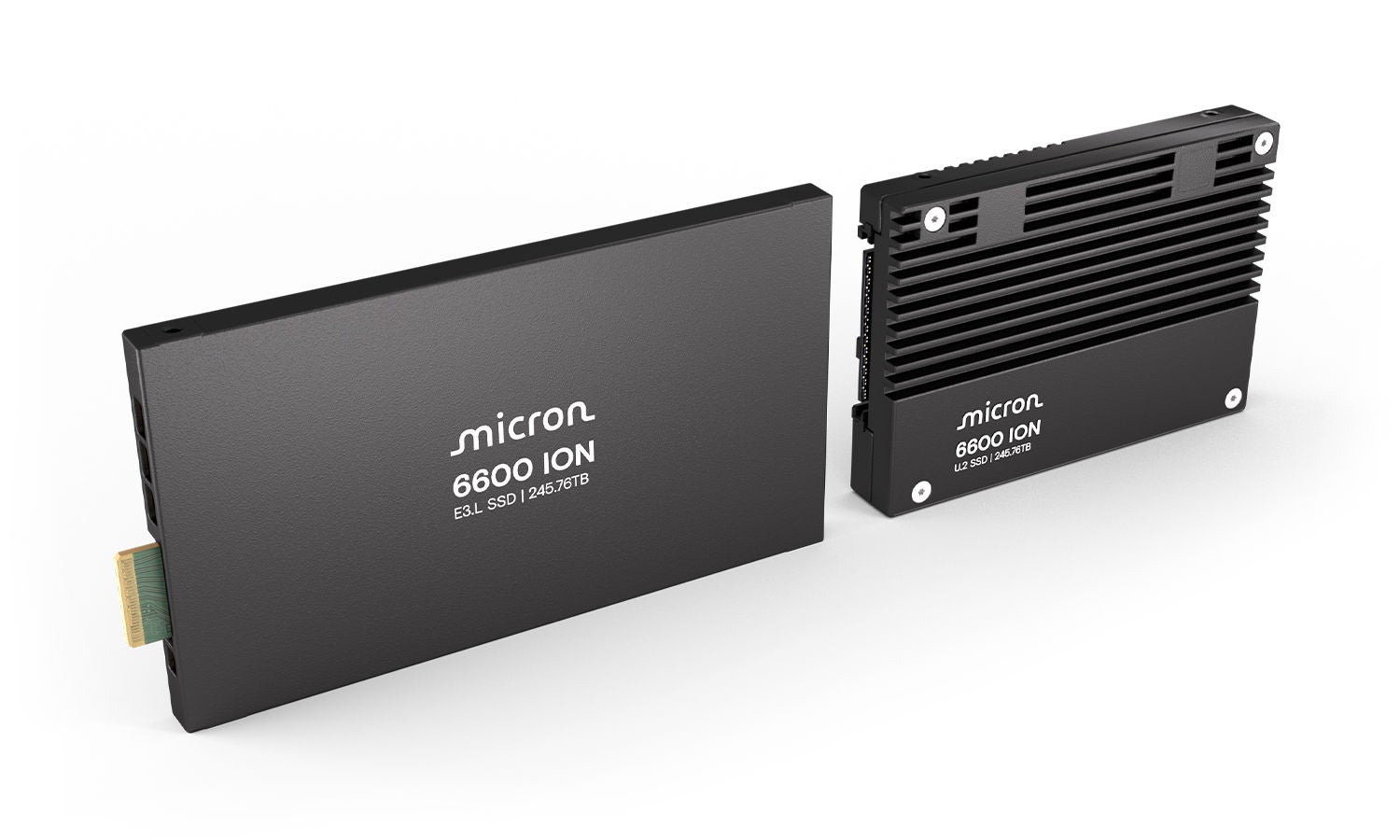
That’s why Micron is now shipping the 245TB Micron® 6600 ION NVMe™ enterprise SSD, the industry’s highest-capacity enterprise data center SSD available today1, delivering nearly a quarter petabyte (PB) of usable storage in a single drive.
More importantly, the 6600 ION 245TB doesn’t just increase capacity. Micron’s workload engineering team has validated its impact across real AI and object storage workloads, showing how extreme-capacity SSDs fundamentally change data center economics compared to HDD-based architectures.
Click image to expand
Why 245TB changes the storage equation
Traditional scale-out storage has relied on adding more drives, more servers and more racks. However, raw capacity alone isn’t enough; architecture must keep up. This model is breaking down under AI-driven data growth. As data centers expand to include AI, operators also need to consider the economics of space, power, infrastructure, performance and capacity to address storage scale with a total cost of ownership (TCO) view across rack-scale and exabyte-scale deployments.
With 245.76TB of usable capacity, the Micron 6600 ION 245TB SSD enables:
- Dramatically higher rack density, with up to 176.9PB per rack in E3.L configurations, compared to just 31.7PB per rack with high-capacity HDDs2
- Fewer drives and much less infrastructure to reach exabyte-scale deployments
- Simplified operations, with fewer components to deploy, monitor and replace over time
In 1EB deployments, HDD-based architectures can require nearly six times more racks than a 245TB SSD-based design2, driving up real estate, power distribution and cooling costs before performance is even considered.
High capacity alone is not enough. AI and analytics workloads demand fast ingest, low latency and efficient access to massive datasets.
The Micron 6600 ION 245TB is built on Micron G9 QLC NAND, delivering a purpose-built enterprise QLC NVMe SSD architecture, including controller, NAND, DRAM, firmware, manufacturing and supply chain logistics — all controlled by and optimized by Micron.
Key architectural advantages over HDDs include:
- PCIe® Gen5 NVMe performance, enabling fast sequential and random access at scale
- Six-plane QLC NAND architecture, increasing internal parallelism for higher throughput
But architecture alone doesn’t tell the full story. That’s where Micron’s workload testing comes in.
What workload testing revealed
Micron’s workload engineering team tested the 245TB Micron 6600 ION SSD against capacity-matched HDD configurations using real, production-relevant workloads in Micron labs.
For AI data pipeline workloads, including data ingestion, preprocessing and movement between storage and compute, our testing showed that a single 245TB 6600 ION SSD delivered:
- Up to 84x better energy efficiency in AI processing (storage-level)
- 8.6x higher throughput (MB/s) in AI preprocessing
- 3.4x higher ingest throughput
- Up to 29x lower latency3
These gains directly translate to faster time to insights, particularly in AI data lake and extract, transform, load (ETL)-heavy environments where storage often becomes the bottleneck.
For object storage platforms supporting AI, analytics and large-scale data services, latency and throughput consistency are critical.
Using MinIO object storage workloads, our testing demonstrated that the Micron 6600 ION 245TB achieved:
- Up to 435x better energy efficiency
- 96x less time to first byte
- 56x higher throughput per watt4
These results highlight a key shift: Object storage performance is no longer constrained by the network or software stack alone — the underlying media architecture fundamentally shapes user experience and infrastructure efficiency.
Power, cooling and sustainability at exabyte scale
Energy efficiency is no longer optional in modern data centers. Power availability and cooling capacity are often the first constraints operators encounter when scaling storage.
The Micron 6600 ION 245TB SSD consumes approximately 30W at maximum power, while delivering 8.2TB per watt, compared to ~4.4TB per watt for high-capacity HDDs, illustrating the efficiency advantages of this PCIe® Gen5 SSD architecture at scale.5
At exabyte scale, Micron workload engineering analysis shows that HDD-based deployments can require nearly twice the total energy of SSD-based architectures delivering the same usable capacity. The result is not just lower drive power, but:
- Reduced cooling demand
- Improved power usage effectiveness (PUE)
- Lower operational costs and carbon footprint over the life of the deployment
In modern AI and cloud environments, rack-level efficiency, not per-drive cost, determines scalability. By dramatically increasing capacity per rack while reducing power and complexity, the Micron 6600 ION 245TB enables operators to scale data growth within fixed physical and electrical constraints.
The Micron 6600 ION 245TB SSD is now commercially available in E3.L and U.2 NVMe SSD form factors, and designed for hyperscale, cloud and enterprise deployments that need to scale efficiently without expanding their data center footprint.
As AI datasets continue to grow, storage architectures must evolve with them. With the 245TB Micron 6600 ION SSD, Micron is helping data centers move from incremental scaling to a fundamentally more efficient future for exabyte-scale data center storage.
More capacity. Less infrastructure. Better performance per watt, at scale.
For more information on the Micron 6600 ION and 245TB, follow this link.
References:
1. SSD and NAND comparisons are based on the top five competitive suppliers of OEM data center SSDs by revenue as of February 2026, as per Forward Insights analyst report “SSD Supplier Status Q1/26.”
2. The decrease in rack space is calculated as 720 drives x 245.76TB SSDs per 36U for 176.9PB capacity total per rack, compared to 720 drives x 44TB HDDs per 36U for 31.7PB capacity total per rack, theoretical maximum. The difference is that 5.6 times more rack space is needed for HDDs.
3. 6600 ION NVMe SSD consistently delivers higher throughput than HDDs for AI extraction, transformation and loading (ETL), with lower latency, superior power efficiency and scalable concurrency as tested in Micron labs with a single 6600 ION 245TB SSD against an array of 16x 16TB data center HDDs from a single HDD manufacturer.
4. MinIO object storage workload testing based on testing in Micron labs using the Warp S3 benchmark with 4MB objects with a single Micron 6600 ION 245TB SSD against an array of 16x 16TB data center HDDs presented as a RAID-0/JBOD array from a single HDD manufacturer.
5. The Micron 6600 ION 245TB SSD operates at 30W peak power, and 44TB HDDs at 10W peak power each. Energy savings are calculated as the difference between the two drives running at maximum power for one year. 44TB HDD power information is not available, comparisons are based on 32TB/36TB HDD peak power, source: Seagate HDD.