



- US - English
- China - 简体中文
- India - English
- Japan - 日本語
- Malaysia - English
- Singapore - English
- Taiwan – 繁體中文

Humanity is on the cusp of an information explosion unlike anything seen before. But the question is, what will we do with all the data we produce?
This is not an inconsequential question. Everything from our everyday computers and smart devices to advanced tech like cars and robots are generating and using data in exponentially increasing amounts.
Five years ago, all the data ever produced by our digital technologies totalled 4.4 zettabytes (ZB). That’s 4.4 sextillion bytes — a number almost too large to comprehend. Today, we have eclipsed that number: We now produce about 16ZB every year, and that number is expected to continue increasing.
We collect, process and store that data using microchips made primarily of silicon, found in sand. Although it is the second most abundant element in the Earth’s crust, silicon in its pure form — the kind required for fabricating many types of computer chips — is rare, making up less than 10% of the total silicon supply.
And we are using it up quickly. According to one study, the total mass of silicon wafers required would exceed the total available silicon supply by 2040, a significant challenge to new technology and digital progress.
One way to avert this disaster is to improve silicon-refinement processes. In addition, researchers are seeking alternative materials for data processing and storage, such as gallium nitride (GaN) and graphene.
But among the alternative materials is another possibility — deoxyribonucleic acid, or DNA.
DNA data storage: nature’s data processor
Every living thing comes into this world equipped with certain information. Our hair and eye color, our right- or left-handedness, the illnesses we are susceptible to, and perhaps even our temperaments are encoded in our inherited traits, which come from our genes. Genes are composed of DNA, which carries the information making us who and what we are.
DNA’s molecular form consists of a double helix, or twin strands of molecules — one of sugar and one of phosphate — twisted around each other. Between the strands are nitrogenous bases shaped like horizontal rods, each consisting of a different chemical. The bases come in four kinds:
- Adenine (A)
- Thymine (T)
- Guanine (G)
- Cytosine (C)
Now that we know the ins and outs of DNA and how it stores information in our bodies, how does DNA store information in our electronics?
“The human body is the most sophisticated storer of information,” says Gurtej Sandhu, senior fellow and vice president at Micron Technology. Sandhu holds more than 1,300 patents in a wide range of technical areas. One of his personal interest and areas of research has been with the use of DNA for data storage.
His inspiration, he says, came from realizing the “enormous amount” of information that our bodies contain in a single cell’s worth of DNA.
“Nature does data compression on a scale that is pretty amazing and in ways that are still not completely understood,” Sandhu says. “So I thought, ‘Why can’t we use DNA as a medium to store information?’”
The many benefits of storing digital data in DNA
As scientists learn more about the DNA molecule and find ways to create synthetic versions, they see a lot of promise when it comes to DNA and data storage. A future class of memory known as nucleic acid memory (NAM) storage could offer a number of benefits.
Density: The amount of information stored in one person’s DNA is massive, Sandhu says. Our bodies contain 5TB (or five thousand billion bytes) of information. According to Sandhu, DNA’s data-storage density is much higher than that of any other storage technology known today.
Under one system, a single gram of DNA could store 215 million gigabytes of data, and a quantity of DNA smaller than a sugar cube could store all the movies ever made. Scaling up even further, a container of DNA about the size of two passenger vans could hold all the data ever created in the world.
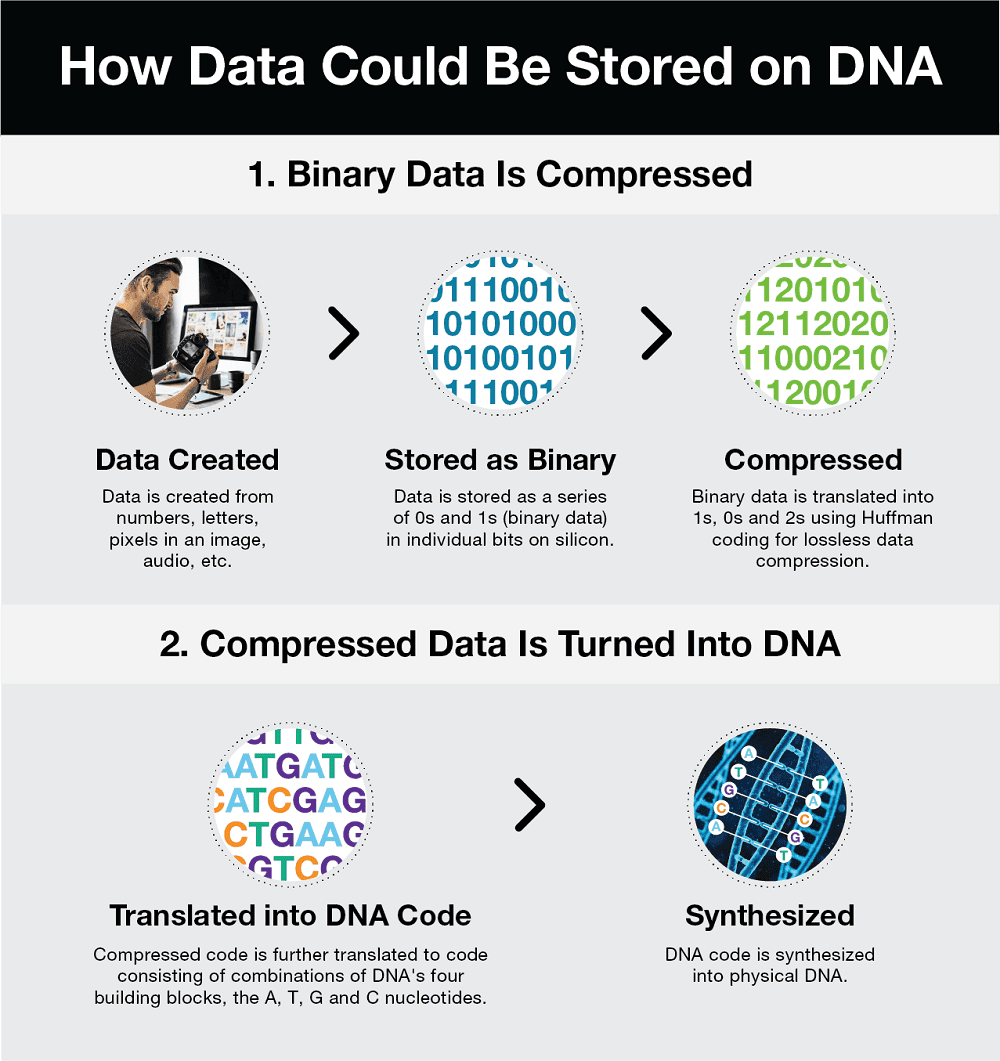
According to Sandhu, one reason for all this density is DNA’s four-part base — A, T, G and C — as opposed to the binary 0-and-1-based system that computing uses now. This doubling allows for “exponential growth” in the amount of information stored. NAM storage encodes information in molecules, packing informational punch in very tiny parcels.
Durability: DNA lasts a very long time — up to 1.5 million years or so when frozen in permafrost. As a data storage medium, it could be viable for thousands or even millions of years. In contrast, the most commonly used medium for long-term storage, magnetic tape, has to be replaced after 10 years.
Sustainability: DNA, even the synthetic kind that would be used in NAM, requires very little energy to store, process and read. Because it regenerates itself, it is also completely recyclable. Plus, it can easily be replicated into many copies of itself, creating a near-infinite supply of DNA digital data storage.
“NAM can store the world’s information for future generations using far less space and energy,” Sandhu and fellow researchers, including George M. Church, Victor Zhirnov and others, wrote in a 2016 Nature Materials article detailing the results of their research.
The long-term potential of DNA storage technology
The researchers are exploring DNA’s use, first, as a long-term storage technology for medical records, surveillance video, historical documents and other archival materials.
The archaic method of magnetic tapes that fill vast libraries of data could be replaced with a relatively small amount of NAM that would last much longer. Ultimately, they hope to develop NAM technologies to replace the use of silicon in computers altogether.
The primary barrier to achieving this goal is cost.
“For our application to read, write, package and store data using DNA, costs need to go down a lot,” Sandhu says. In one project, the cost of synthesizing 2MB of data was $7,000; reading it cost another $2,000. And reading and writing to DNA is slower than to other kinds of memory storage.
Sandhu is optimistic that, in time, these challenges will be resolved. The price of sequencing DNA has fallen considerably, he points out, from $31,250 per megabase (or 1 million base pairs of DNA) in 2002 to as little as 50 cents per megabase as of 2024.
And research into NAM is stepping up. With funding from research groups such as Harvard University, the European Molecular Biology Laboratory and the Semiconductor Research Consortium (or Symbio), all developing DNA-based data storage technologies.
A bright future for DNA data storage
Running out of computer-grade silicon could bring the world to a halt if it happened today. Given the pace at which we are producing data, depleting the world’s silicon supply is a real concern, but Micron is stepping up to resolve this challenge. As a leading manufacturer of computer memory technologies, we are in an excellent position to lead the charge toward better, faster, more sustainable digital memory solutions.
Sandhu thinks it’s possible that DNA-based NAM will soon be ready to augment Micron DRAM, NAND, and other silicon-based memory technologies. Someday, this form of memory storage could become the norm, replacing silicon altogether.
Meanwhile, the very process of developing NAM could yield other equally important results, Sandhu says:
“Imagine the memory side of things 100 years ago when magnetic cores were used — then electronic memory, disc drives, small magnetic memory and so on. For those, we needed a knowledge of the mechanical side of things.
“DNA is 10 times more complicated. We will need to be inclusive. We need memory, microfluidics, chemistry, molecular biology. For this technology to work, the amount of collaboration and breadth of technical and scientific involvement by different people will have to be huge. It will take the entire breadth of skill sets to make this happen.”
Micron is the memory maker, which is why we lead the industry in imagining and creating new memory technologies. But it will take collaboration among experts in diverse fields to make technologies like DNA data storage a functional reality.
“There’s no example like this from the past, in our industry or any other,” Sandhu says. “It’s going to be an amazing opportunity for collaboration. And we are barely scratching the surface.”