


- US - English
- China - 简体中文
- India - English
- Japan - 日本語
- Malaysia - English
- Singapore - English
- Taiwan – 繁體中文
I've spent my adult life in the semiconductor industry, making numerous projections, forecasts and predictions in roles ranging from product management to content marketing. Whether it was product demand forecasting or making predictions on emerging tech trends, I've had my share of hits and misses.
Recently, I revisited an article I wrote seven years ago titled "How do self-driving cars work?" It's still one of the most read pieces I've created for Micron. In the article, I explored what the future of autonomous vehicles might look like and made predictions about how quickly the technology would evolve. At the time, the industry was buzzing with optimism, and many believed full autonomy was just around the corner.
Since then, the automotive landscape has undergone some changes. Electrification has moved from a niche trend to a global priority, with electric vehicle (EV) adoption accelerating as battery technology improved and governments tightened regulations. In fact, global EV sales exceeded 17 million units in 2024, representing 20% of all car sales worldwide, up from just a few million in 2018. Vehicles have evolved into software-defined platforms, enabling over-the-air updates and AI-driven features that were barely imaginable in 2018. Connectivity and data have become central to the driving experience. Full autonomy has progressed more cautiously than expected, constrained by safety, regulation and consumer trust. In that time frame, the COVID-19 pandemic introduced supply chain disruptions, semiconductor shortages and shifting consumer behaviors that reshaped how cars are built and sold.
However, autonomous driving still remains the north star of the automotive industry. So let's reflect on my 2018 article, examine how the shift in megatrends has impacted the predictions and, ultimately, review what I got right and wrong.
“Artificial intelligence drives autonomous cars”
Verdict: Right
For an automobile to be autonomous, it needs to be continuously aware of its surroundings — first by perceiving (identifying and classifying information) and then acting on the information through the autonomous computer control of the vehicle. Autonomous vehicles require safe, secure and highly responsive solutions in order to make split-second decisions based on a detailed understanding of the driving environment. Understanding the driving environment requires an enormous amount of data to be captured by a myriad of different sensors across the car, which is then processed by the vehicle’s autonomous driving computer system.
This section remains true today. AI is the key driver of autonomous vehicles, now more integrated into modern cars than ever. Processing that much data is still a challenge for autonomous vehicles and edge AI workloads, but the compute, memory and storage that enable autonomous driving have become more capable and powerful. Increased storage and memory capacities allow vehicles to handle larger datasets and more complex algorithms, enhancing the accuracy and responsiveness of AI systems. This advancement enables more complex training models, faster inference and new AI applications we hadn't envisioned seven years ago. The rise of generative and agentic AI has brought AI to vehicles in ways we couldn't have imagined, transforming infotainment and ADAS systems alike. Drivers now expect their vehicles' AI to deliver more than just basic commands like "call home"; they seek sophisticated, conversational AI experiences.
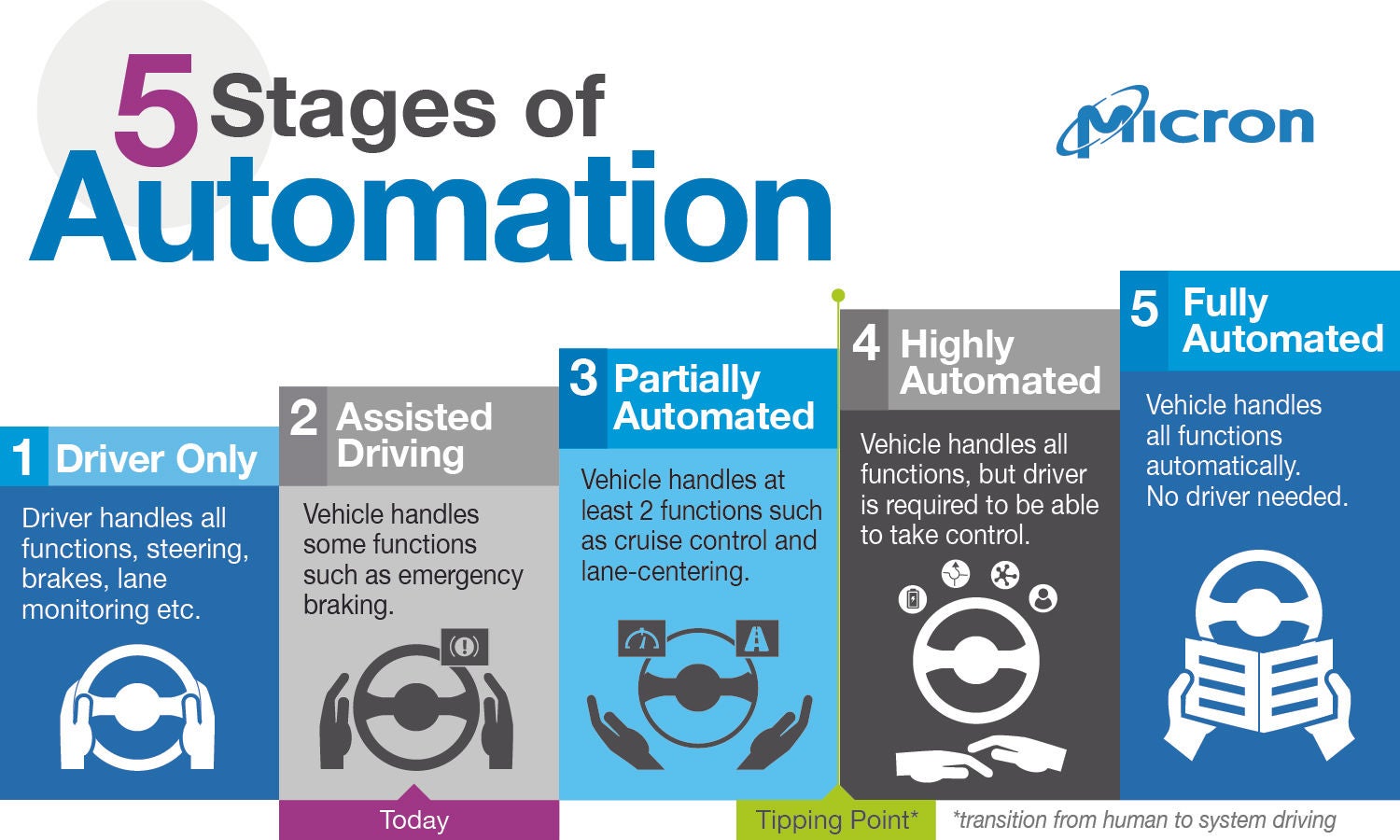
(Click image to enlarge)
Infographic 1: The 5 Stages of Automation
“Five stages of automation infographic”
Verdict: Right but updates are needed
Besides the brand color scheme and old Micron logo, this infographic on the five stages of automation is still accurate and relevant today (and is a nostalgic throwback for me). We didn’t coin the five stages of autonomy; it's an industry standard established by the National Highway Traffic Safety Administration (NHTSA). The major update needed for this visual is the "today" position. Many new vehicles are now in the "Partially Automated" stage, with some advanced EVs capable of stage-four autonomy. Stage-five technology exists and is seen in limited cities through pilot programs, though they are generally limited to warm and predictable climates. To be considered truly at stage five, a vehicle would have to be able to handle any situation and climate condition that it could encounter. So why aren’t all new cars fully autonomous? The list of obstacles is extensive and includes government regulation, safety concerns and total cost of ownership. Perhaps we will be at stage five within the next seven years. That possibility draws closer as Micron continues to make groundbreaking innovations in memory bandwidth and centralized automotive storage architectures. Memory bandwidth and centralized architectures enhance performance, reliability and safety, all of which are critical for achieving stage-five autonomy.
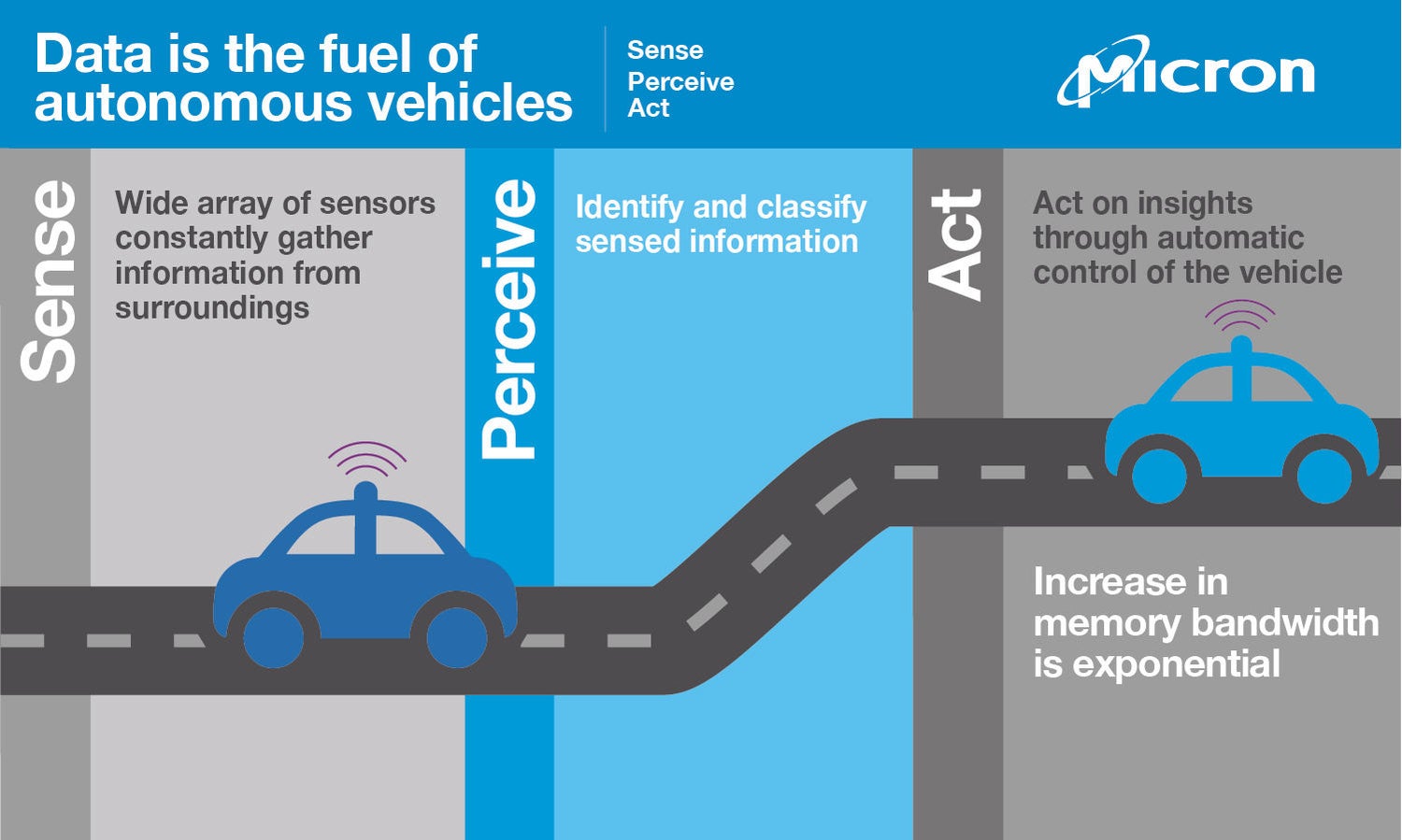
(Click image to enlarge)
Infographic 2: Data is the fuel of autonomous vehicle.
“Memory, the unsung hero in autonomous driving” and “high-speed memory is an essential component of autonomous driving”
Verdict: Right and as true as ever
Memory and storage technologies are crucial for autonomous vehicles at any level of autonomy. AI in cars must handle vast amounts of data to make quick decisions at high speeds. For autonomous driving, excessive delays and latency are unacceptable. Humans are pretty good at making snap decisions, despite what we may observe in traffic. The problem is that we get distracted easily. Computers don’t. Cameras, lidar and sensors are always vigilant. High-performance vehicle computing platforms don't nod off behind the wheel and are always calculating and making decisions to keep everyone safe, as long as they get the data they need from memory and automotive storage. High-bandwidth memory and centralized storage solutions are crucial for tackling these data challenges and keeping the system running smoothly, efficiently and safely.
Memory is also essential for complex AI training models and for enabling rapid inference responses. Micron’s innovations provide the reliable foundation needed for these demanding AI tasks. By making reliable and efficient memory and storage, Micron plays a key role in integrating AI into vehicles, advancing autonomous driving capabilities.
“The importance of GDDR6 in the future of autonomous driving”
Verdict: Wrong
At the time, Micron’s GDDR5X memory was being used in automotive solutions. GDDR5X and GDDR6, primarily for gaming, also entered automotive solutions and networking applications due to their high-speed capabilities. Today’s graphics and AI applications are using GDDR7, the latest graphics memory standard. The expectation was that this trend would continue in automotive solutions, especially in infotainment systems, where screens are getting larger and offering higher resolutions. Vehicles like the Tesla Model 3 and Cybertruck even offer an in-car gaming feature called Telsa Arcade, where video games can be played on the infotainment system using the pedals and steering wheel (not while driving for safety reasons). So why did we get this wrong? It seems logical that the need for more bandwidth and graphics memory would grow, right?
The need for more memory and bandwidth continues, and increases with each level of autonomy, but today the type has changed to low-power double data rate (LPDDR) memory. Originally built for low power consumption in mobile phones, LPDDR, specifically LPDDR5X, became the best fit for modern vehicles.
Mobile phones and cars share many similarities: They don’t stay connected to a power outlet, they run on batteries and they are full of sensors and compute that constantly gather and monitor data. AI interactions have become expected from users. Micron continues to innovate low-power memory solutions to increase performance and lower power consumption to meet these expectations.
One recent example is the introduction of LPDDR5X DRAM with direct link ECC protocol (DLEP). This LPDDR5X-optimized error correction code (ECC) scheme mitigates all system in-line ECC, which helps to deliver a 15% to 25%1 bandwidth increase. DLEP not only delivers increased performance but also helps LPDDR5X memory systems achieve the ISO 26262 ASIL-D hardware metric through reduced failures in time (FIT). Additionally, this new product delivers approximately 10% lower power consumption on a picojoule-per-bit (pJ/b) perspective and a minimum 6% additional addressable memory space2. Built on the backbone of Micron’s certified ISO 26262 ASIL-D systematic LPDDR5X DRAM, critical automotive functional safety (FuSa) requirements are now readily achievable. Simply put, DLEP increases bandwidth and reduces power consumption, the holy grail of win-win solutions for autonomous driving workloads.
But what type of memory comes next for vehicles? Will LPDDR continue for the next seven years, or will a new memory architecture move into vehicles? The latter is likely to happen, especially as AI becomes more prevalent and necessary for fully autonomous driving where system bandwidth and power efficiency requirements continue to drive memory innovation forward. I’ll give one parting prediction: It won’t take seven years for the next memory architecture to be adopted into an autonomous vehicle.
Conclusion
I won’t start keeping score on my predictions (I’m not sure my ego could handle that), but revisiting them is a useful exercise to gauge our perspective on future technologies and trends. The No. 1 takeaway is that in the past seven years, the focus and value of AI in vehicles has increased exponentially and the importance of high-performance memory and storage solutions for AI-powered vehicles has done the same. The specific memory and storage solutions may change, evolve and improve, but the challenge they solve does not. Data is at the core of all AI, and data lives in Micron memory and storage solutions. But our technology doesn't just store data; it accelerates the transformation of data into actionable intelligence.
1 Measured against typical in-line system ECC schemes vs. DLEP
2 “additional addressable memory space” based on recovered memory density used to store system ECC parity